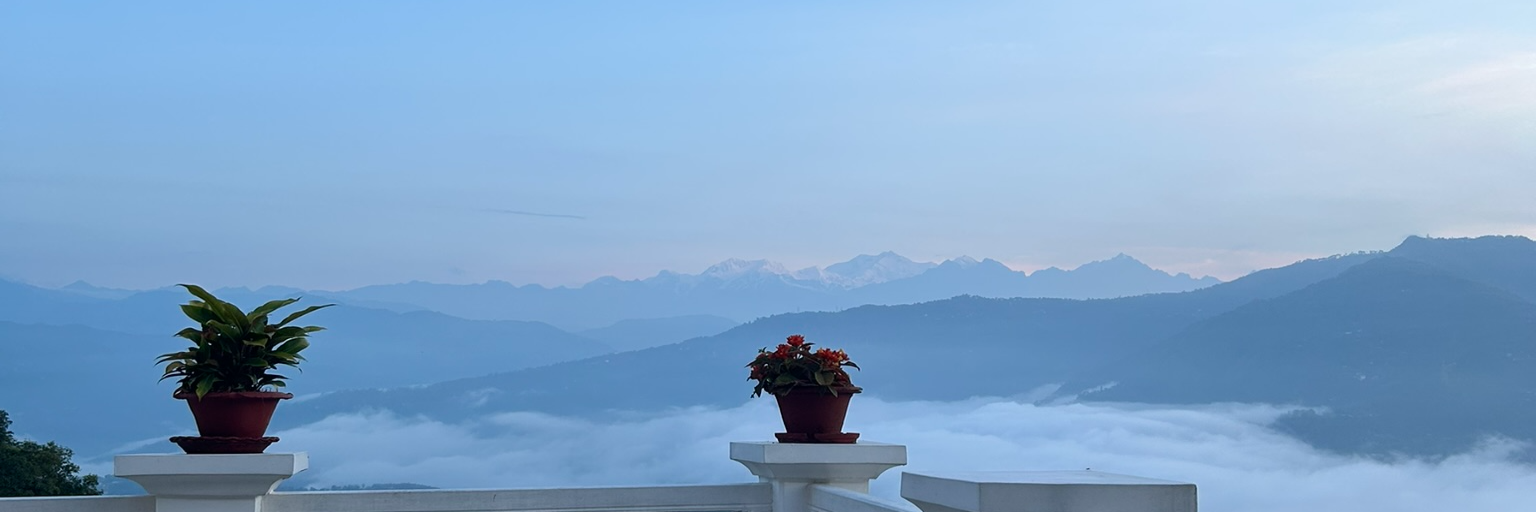
Through the clouds in the land of the Thunder Dragon
My journey through India, Bhutan and Kathmandu
There are trips you look forward to, and then there are trips that leave you wondering how you were lucky enough to experience them. My recent journey through India and Bhutan, finishing with a brief visit to Kathmandu, was firmly in the second category. There were Himalayan peaks above the clouds, extraordinary places to stay and a monastery seemingly attached to a cliff by sheer determination. But some of my favourite memories were much smaller: conversations over dinner, an unexpected wildlife encounter and a game of football that turned out to be rather special.
Kolkata: history brought to life
I was fortunate enough to fly business class with Qatar Airways on my journeys to and from the region. It was an amazing way to begin and end the adventure, and very much part of the experience.
Kolkata gave me plenty to get excited about straight away. My base was Glenburn Penthouse, where the infinity pool looks out across the city towards the Victoria Memorial. Lying on a lounger at dusk, taking it all in, I attracted the attention of a large bird of prey. I’m fairly sure it was checking whether I might be something worth eating!
What really made Kolkata for me, though, was my guide, Pretti. She was a proper history buff, which suited me perfectly. If you listen to Empire or The Rest Is History, you’ll understand the pleasure of finally standing in places you’ve heard discussed and having someone knowledgeable bring their stories to life.
The itinerary brought together the historic streets around Dalhousie Square with Kolkata’s wider cultural highlights. Grand buildings, the Victoria Memorial and the city’s living streets gave us plenty to explore, but it was Pretti who connected those places with the history that interested me.
That is where a good guide makes such a difference. She helped me understand both the stories behind the buildings and the city around us today.
I explored on a Saturday, which felt relatively quiet by Kolkata’s standards. There was still tonnes of life, but it gave us a little more breathing space. One practical tip from my visit: avoid exploring on Mondays, when some museums and attractions close.
Glenburn: slowing down in the Himalayan foothills
From Kolkata, a short flight took me to Bagdogra, followed by the drive towards Darjeeling and into the Himalayan foothills.
The journey itself was part of the attraction. As we climbed, wisps of cloud wound through the hills, revealing forest and tea-covered slopes before swallowing them up again. One minute there was an incredible view; the next, we were driving through cloud so thick you could barely see ten feet ahead.
My base for two nights was Glenburn Tea Estate, and I could happily have stayed longer.
The setting is magnificent, with the snowy peaks of Kanchenjunga in the distance. It is the world’s third highest mountain, which is quite something to have as a backdrop to your stay.
Glenburn was wonderfully peaceful, although the cicadas occasionally had something to say about that. Some of them had definitely had their Weetabix. There were birds everywhere too, and I spent a fair bit of time trying to identify them with the Merlin bird app.
The food was excellent, and the manager joined me for dinner, sharing stories about the estate and its history. Those conversations over gin & tonics added so much to the stay.
A visit to the working tea factory is a must. Seeing the process gives you a different appreciation of what ends up in your cup. My favourite was the Moonshine tea – really lovely.
There are walks to waterfalls, fishing opportunities and plenty to do, but Glenburn is also somewhere to give yourself permission to sit, look and listen. For anyone combining India with Bhutan, I found these two nights a wonderful change of pace.
My departure brought a final surprise. We left early for Bagdogra, winding along the switchback roads in the darkness, when a leopard crossed in front of us.
It paused in the headlights, then lingered behind the car as we passed. Our driver suggested it might have been heading towards a nearby village, where livestock can attract them. Whatever its destination, it was an extraordinary bonus on an airport transfer!
Arriving in the Land of the Thunder Dragon
For the flight from Bagdogra to Paro, I had a window seat on the left-hand side. On our flight, that gave me magnificent views of the Himalayan giants rising above the clouds.
Then came the approach into Paro.
We flew so close to the hillsides that I could make out people outside their houses. It was a remarkable arrival, followed by an airport that is beautiful in its own right. Almost immediately, I felt that Bhutan, the Land of the Thunder Dragon, was somewhere special.
Here I joined my Travel Counsellors colleagues. We all felt very fortunate to be sharing this adventure, and it was lovely to have people around who were just as excited by everything we were seeing.
Thimphu: getting to know Bhutan
Our first two nights were at Six Senses Thimphu. The programme began with a presentation by a Buddhist scholar on Gross National Happiness, offering context for a country where wellbeing, culture and spiritual life are part of the conversation about development. It was a useful introduction before setting out to explore.
Our day in the capital brought together landmarks such as Buddha Dordenma, the great Buddha overlooking the city, and the National Memorial Chorten, where people come to pray and turn the prayer wheels. The itinerary also included the Bhutan Postal Museum where you can have your own photos turned into stamps and then send postcards with those back to friends and family.
We even came closer to a royal encounter than expected when the King passed us at the hotel where we were having lunch. I can’t claim we actually met him, but it certainly gave us something to talk about.
Our time at Six Senses Thimphu included an attempt at Bhutanese darts. I can safely say this is not a hidden talent of mine.
I had considerably more success with an early-morning swim in one of the most beautiful pools I have ever seen. Swimming at the crack of dawn, with that setting around me, was a moment worth getting up for. I decided against attempting yoga. There was no need to embarrass myself twice.
Gangtey: a valley and a very memorable football match
From Thimphu, our route took us over Dochula Pass, with its 108 chortens arranged across the hillside, and onwards via Wangduephodrang Dzong towards Gangtey. These journeys deserve time in the itinerary: the stops and changing mountain scenery are part of the experience.
Gangtey, in the Phobjikha Valley, was one of the places I loved most. We had two nights here, with time for Gangtey Goenpa monastery and the Gangtey Nature Trail. The hike gave us a chance to enjoy the landscape properly, away from the bus and taking in the quiet of the valley.
It also brought one of the most unexpected encounters of the trip.
We played football with a young boy wearing a yellow top, who had a cardboard cut-out of the World Cup trophy. Only afterwards were we told that he had been recognised as a reincarnate lama associated with the monastery.
About 30 minutes later, we saw him taking part in a religious ceremony. Before it began, he turned towards our group and gave us an enormous cheeky grin.
The valley’s hotels offer some extraordinary views, and I would love to return when the black-necked cranes are there in winter. It was beautiful during our visit but seeing those birds would add another reason to spend time here.
Punakha: remarkable buildings and memorable hospitality
Punakha was another highlight. Our programme included Chimi Lhakhang, a temple set among the valley’s fields and known for its association with fertility blessings, before a fuller exploration of the valley. Be prepared for a lot of phallic imagery though. There’s a lot throughout the country but they really go all out here!
Next was Punakha Dzong, a monastery-fortress set where two rivers meet, is one of the most beautiful collections of buildings I have ever seen. Photographs give you an idea, but being there allows you to appreciate the whole setting and the detail.
We stayed at Pemako, where the arrival is an experience in itself. You cross a suspension bridge on foot before a golf buggy takes you onwards to your accommodation. It is a superb property, and the journey into it creates a real sense of anticipation.
Another favourite was our visit to Gatshothang Farmhouse. We crossed a footbridge, walked through the valley and arrived to wonderful home cooking and lemonade.
Afterwards, another high suspension bridge gave us a shortcut back towards the Pemako side of the river, while our bus took the longer road route to meet us.
Tiger’s Nest: worth every step
Our final two nights in Bhutan were in Paro, with Taj Paro Resort & Spa as our base.
The highlight, of course, was Taktsang Monastery, better known as Tiger’s Nest.
Even having seen countless photographs, I found it difficult to put into words how impressive it is. The monastery clings to the cliff like a swallow’s nest, looking almost impossible from below.
The walk is a proper effort, and I was pleased I had put in some preparation before travelling. It is worth taking your time, catching your breath and enjoying the changing views along the way.
I personally found it less daunting from a heights perspective than the photographs had led me to expect, although there are steep steps and sections beside drops, so that will depend on your own comfort.
Reaching the monastery was an extraordinary feeling. You cannot take photographs inside, which means there is part of this experience I simply cannot show you. You will have to go and discover it for yourself.
Our final evening’s programme included a traditional Bhutanese cultural performance, bringing music, costume and dance into the mix. After the walk to Tiger’s Nest, it was a lovely way to round off our time in Bhutan.
A day in Kathmandu
My final stop was Kathmandu, with another flight offering cracking Himalayan views before we landed.
After Bhutan’s valleys, the scale of the city was striking. I had only a day, but a guided tour gave me a chance to see several of its highlights.
Kathmandu Durbar Square brought together the old city’s royal history, courtyards, temples and shrines. Then came Swayambhunath, better known as the Monkey Temple, set on a hill above the city. Its painted Buddha eyes and prayer flags are instantly recognisable, but the setting also helps you appreciate just how far Kathmandu stretches around you.
The afternoon’s itinerary took in Pashupatinath, the Hindu temple complex beside the Bagmati River. Together, these visits offered a brief introduction to the city’s history and to the religious traditions that remain part of everyday life here.
It was enough to leave me wanting more time. Nepal deserves a journey of its own, and this short introduction has certainly given me a reason to return.
What I brought home
Looking back, the variety is what made this journey work so well: history in Kolkata, time to slow down at Glenburn, then Bhutan’s remarkable valleys, monasteries and hospitality.
The places to stay were exceptional, but the people brought the trip to life.
It also reminded me why I value travelling myself. An itinerary can tell you where you will go and what you will see. Being there helps me understand how a journey feels, where to allow more time and which experiences might be just right for a particular client.
If India, Bhutan or Nepal has been somewhere in the back of your mind, I would love to help you explore the possibilities. There is a great deal to discover – and getting the pace and details right makes all the difference.